
Multibody dynamics (MBD) simulation consulting
A multibody dynamics model is a complete machine in software: its masses, joints, springs, bushings, tires and contacts, solved through time. It shows how the machine moves and what load every part carries, before the hardware exists. DSIM builds these models in Adams Solver for teams that design vehicles and machines, and turns the results into design decisions.
What a multibody model answers
- Will the mechanism move as designed, through its whole range, without binding or interference?
- What loads reach every joint, bushing, pin and mount, for the structural and fatigue analysis?
- Does the vehicle ride, handle and resist rollover as required, before a prototype is built?
- Which spring, damper, geometry or mass change fixes the problem without creating a new one?
- Why did the prototype fail a test, and which change makes it pass?
Where MBD simulation pays off
Vehicle dynamics
Full-vehicle ride, handling and rollover models, with suspension kinematics and compliance set from measurements or design data, for conversions, variants and new platforms.
Durability loads
Load histories at every hard point over durability events and rough roads, ready for the FEA team, or carried through to stress and weld fatigue in house.
Tracked and off-road vehicles
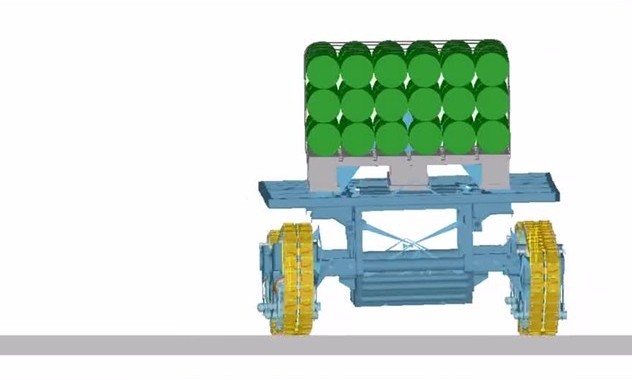
Track systems, road wheels and hulls over terrain and obstacles, including mobility on soft soil, for defense, autonomous and off-highway programs.
Linkages, booms and mechanisms
Dig, lift and haul cycles, cylinder and hydraulic sizing, and stability across the operating range of loaders, lifts and attachments.
Flexible bodies and stress
Craig-Bampton flexible bodies from the finite element model, checked before use, with transient stress recovered on the structure as it moves.
Coupled physics
Bulk material from EDEM coupled to the machine model, and controls brought into the loop, so the loads come from the physics rather than from an assumed force.
Proof from real programs
An autonomous tracked vehicle, validated before metal was cut
A full-vehicle Adams Solver model with track systems over terrain and obstacles, and transient stress on the flexible frame. Design changes came from the model, and the prototype was built on time and under budget.
Client resultSkid steer bucket loads, before the machine existed
EDEM material simulation coupled to the machine model through the dig cycle gave a power envelope for sizing the hydraulics while the design was still open.
DSIM reference studyA welded trailing arm through a virtual durability course
Stress along every weld over humps, bumps, chuck holes and rough roads. Over the assumed road mix the original arm lasts about 5,200 miles; the final design, 12.6 lb heavier, reaches about 400,000.
“Darren brought our simulation capacity to an entirely new level. We engineered an innovative hybrid mining shovel and validated new design and controls concepts through simulation, without spending excess money on tests.”
Multibody simulation for engineering teams at Oshkosh, Magna, Ricardo, Achates Power, Knapheide, SAF-HOLLAND, Caterpillar, Genie, Crown, Joy Global, Toro and Bosch.
How an MBD project runs
Start from the decision
Every model begins with the question it has to answer and the decision that depends on it. That sets how much detail the model needs, and keeps it from growing into a replica of everything.
Build it right-sized, and check it
Mass properties, kinematics and statics are checked before any dynamic run, and the model is compared to test data wherever it exists. Every assumption is written down with the results.
Run the scenarios, then the design space
Once the model is right, the cost of another run is small. Sweeps, design of experiments and optimization can run overnight and rank the parameters that actually matter.
Deliver answers you can act on
Loads, motions, recommendations and the model itself. Work results-only, or open-book with your engineers following the modeling as it happens, as a first step toward capability in house.
Tools, and why independence matters
In house, DSIM standardizes on Adams Solver, with flexible bodies built from the finite element model and in-house stress and fatigue for weld life. Darren has also worked in Simpack, Simcenter 3D Motion, RecurDyn, MotionView, Project Chrono and MATLAB Simscape, and uses EDEM for bulk material. DSIM sells no software, so the recommendation is the model your question needs, not the tool a reseller carries.
The method notes behind the models are public in the Lab, from the Adams Solver settings we never leave at default to six checks on a flexible body. For the business case, see why MBD simulation pays.
Common questions about MBD consulting
What does an MBD simulation consultant deliver?
What do you need from us to start a multibody model?
Do we need to buy Adams Solver or other simulation software?
How do you know the multibody model is right?
Can the MBD loads feed our structural and fatigue analysis?
Rigid or flexible bodies: which does the study need?
Have a machine that needs a model?
Tell me what the machine does and which decision is waiting on an answer. You will get a straight read on whether multibody simulation pays off, and what a right-sized first model looks like.
NDA-ready and US-based.