
Every Adams Solver run integrates the equations of motion with settings most models never change: the integrator formulation, the largest time step it may take, and the error it accepts at each step. On vibration the defaults can be far off, and the answer still looks reasonable. We measured how far on a case with an exact answer.
The test
- The part. A generic cast-aluminum e-drive housing, 12.8 lb, as a linear flexible body (242 Craig-Bampton modes, checked against the full model), on three rubber mounts.
- The input. A sharp 225 lbf tap at the input bearing seat, like a modal hammer, then 30 ms of ringing.
- The exact answer. The same reduced model solved as a linear system, with no time-stepping error at all. Any difference from it is the solver settings.
- The damping. 1 percent of critical on every mode, in every run and in the exact answer, so only the integrator settings differ.
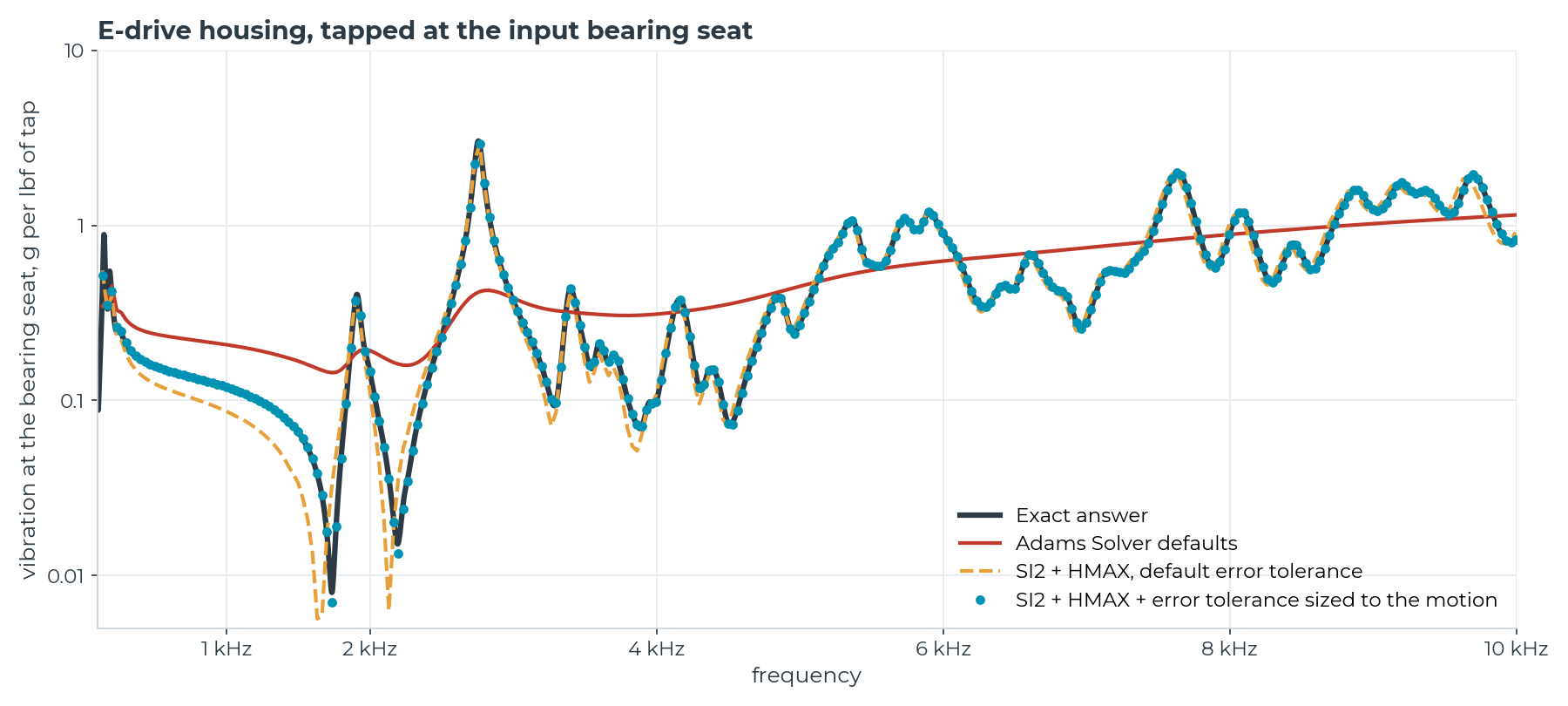
What each setting did
| Settings | Off the exact answer, where the response is strong | Solve time, 30 ms |
|---|---|---|
| Adams Solver defaults: GSTIFF I3, error 1e-3, no maximum step | 39 dB, about 90 times | 2.4 s |
| The same, with output every 50 microseconds instead of 10 | 91 dB | 0.6 s |
| I3 with a tight error and a 2 microsecond maximum step | 45 dB | 8.9 s |
| SI2 and a 2 microsecond maximum step, default error | 5.3 dB, about 1.8 times | 8.2 s |
| SI2, 2 microsecond maximum step, error 1e-6 | 0.01 dB | 9.4 s |
A decibel (dB) compares two amplitudes: 6 dB is a factor of 2, 20 dB a factor of 10.
Why the defaults miss
- I3 checks positions only. Velocities and accelerations come along unchecked. On this vibration model they came out wrong at every step size we tried, down to 2 microseconds.
- Without a maximum step, the output step is the limit. Change the plot resolution and the physics changes with it. At a 50 microsecond output step the solver took steps longer than the 40 microsecond tap itself.
- The error tolerance is in model units. In meters the default 1e-3 is about 0.04 in, and this housing moves 0.0002 in. The solver is satisfied long before the answer is right.
- Flexible-body damping has a default too. Adams Solver applies 100 percent of critical damping to every mode above 1 kHz unless told otherwise. Out of the box, every mode of this housing is critically damped and its resonances simply vanish.
The settings we use
- The SI2 formulation, which controls velocity error as well as position error.
- A maximum step (HMAX) with at least ten steps per cycle of the highest frequency that matters, and shorter than the shortest input.
- An error tolerance sized to the motion that matters, then halved once to prove the answer has stopped moving.
- Modal damping set on every flexible body, from test data or a stated assumption.
- Output at least two and a half times the highest frequency that matters.
Set up properly, Adams Solver resolves this kilohertz ringing to within 0.01 dB of the exact answer in every band up to 10 kHz, the highest we checked, and the error does not grow with frequency. With the defaults it does, from 23 dB off below 2 kHz to 39 dB off between 8 and 10 kHz. The defaults are the problem, not the solver. The accurate run took four times as long as the defaults, seconds in absolute terms: cheap insurance against a wrong answer that looks right.
We then re-ran our own durability study with these settings, and its weld lives fell by more than half. The study now uses them throughout: the trailing arm study.
Solved in Adams Solver. The exact reference uses the same reduced model, so the comparison isolates the solver settings; it does not test the model against hardware.