
Case Study
Predicting Bucket Loads on a Machine That Did Not Exist Yet
How DSIM coupled EDEM discrete element material simulation with MSC Adams multibody dynamics to give a heavy-equipment OEM the power requirements for sizing hydraulic components on a concept-stage skid steer loader, with bucket forces that emerged from the physics rather than from any programmed force equation.
The Challenge
A heavy-equipment OEM was developing a new, high-efficiency skid steer loader, and the program was still at concept stage: no physical prototypes existed and many design parameters were open. One of the earliest decisions on the table was sizing the hydraulic components, and that sizing depended on a number nobody had: the power required to operate the bucket attachment across the varying material types the machine would actually work. Every hydraulic sizing decision downstream would inherit whatever error that load estimate carried, so accurately representing the material loads on the machine was paramount.
The traditional load-estimation paths were the real obstacle. Crude force models produce numbers quickly but are not credible enough to size hardware against. Semi-empirical approximations can be made accurate, but only after exhaustive effort to develop and correlate them, and with no prototype there was nothing to correlate against. The program needed physics-based bucket loads before any hardware existed, faster than either approach could deliver them.
The Approach
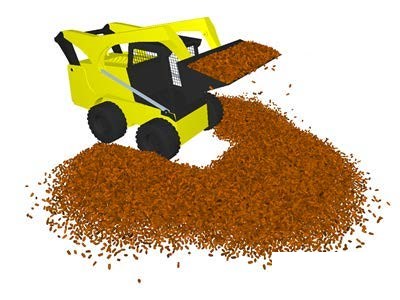
DSIM coupled EDEM, a discrete element method (DEM) material simulation, with MSC Adams multibody dynamics. We built an Adams model of the skid steer loader carrying the driving motions of a typical operational scenario and ran it in co-simulation with EDEM: Adams controlled all system dynamics while EDEM computed the granular material response and fed the resulting forces back onto the bucket. Machine and material pile solve together, so the load path from material to machine is computed, not assumed.
Material properties were not guesswork either. EDEM's GEMM database of material models let the full loading and unloading cycle be tested in multiple material piles with no guesswork on material parameters. That is the core of the EDEM Adams coupling: the load case is generated by physics rather than programmed by hand, and changing the material means swapping the pile, not re-deriving and re-correlating an equation.
The Physics Is the Proof
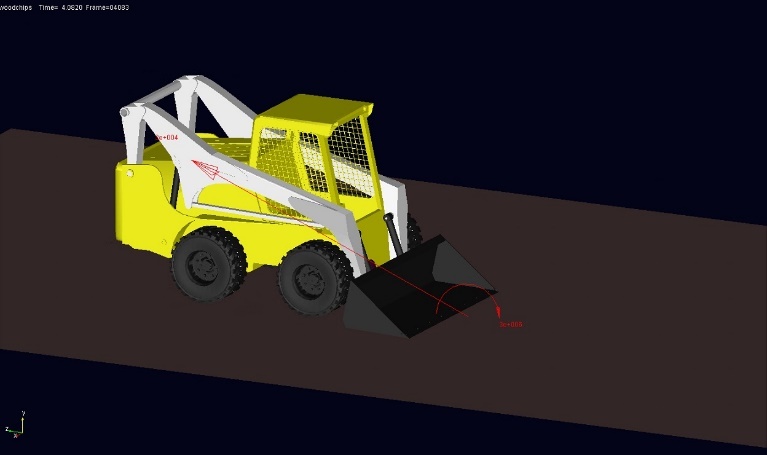
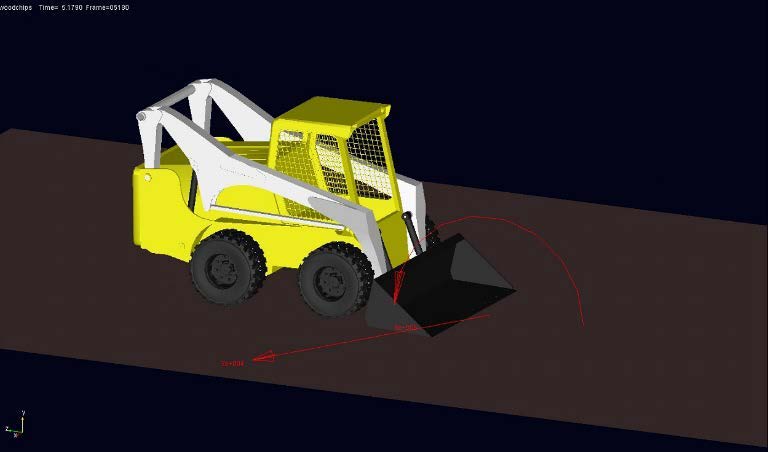
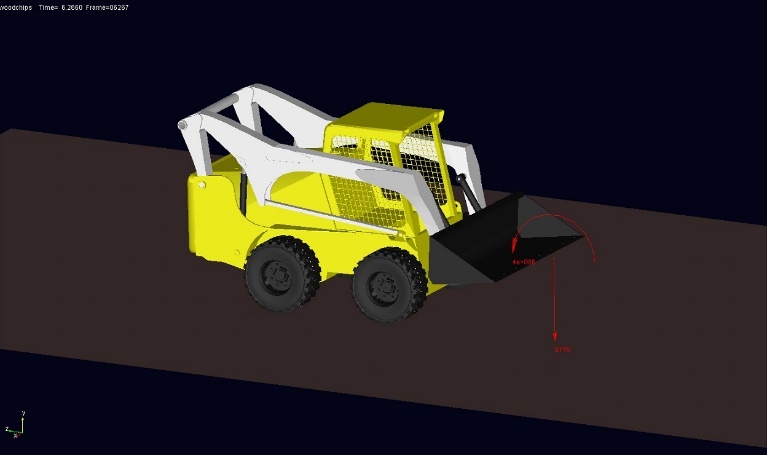
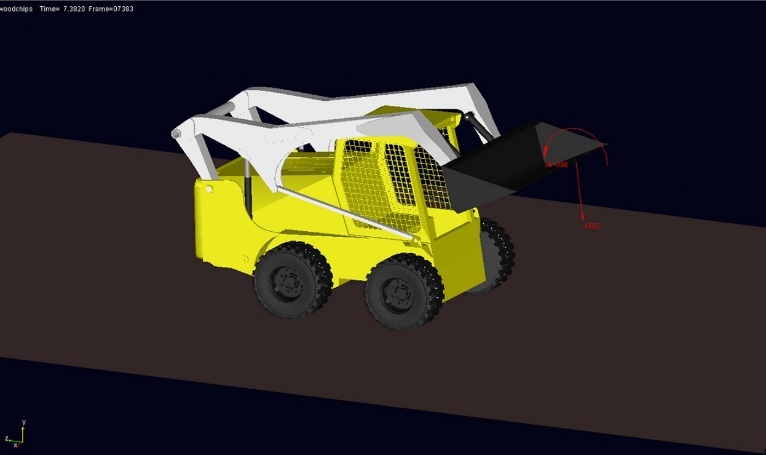
The strongest evidence that the coupling is doing real physics is what the bucket force vector did through the dig cycle. No force equations were empirically programmed anywhere in the model. Every load emerged from the physics-based DEM material interacting with the bucket geometry, and the behavior matches what is seen in physical test data with buckets.
1. Penetration and bulldozing
As the bucket drives into the pile, the force vector points rearward and up.
2. Accumulation
As material builds up ahead of the bucket while bulldozing continues, the vector shifts rearward and down.
3. Lifting
The force magnitude exceeds the weight of the carried material, because the material is being accelerated upward, not just held.
4. Rearward acceleration
A slight forward force component appears, produced by the inertia of the carried material.
Phases 3 and 4 are the tell. A static or semi-empirical load model gives you material weight; it does not give you the inertial overshoot during lift or the forward reaction under rearward acceleration unless someone thought to program those effects in. Here they fell out of the physics, which is what makes the loads trustworthy in operating conditions nobody wrote an equation for.
The Result
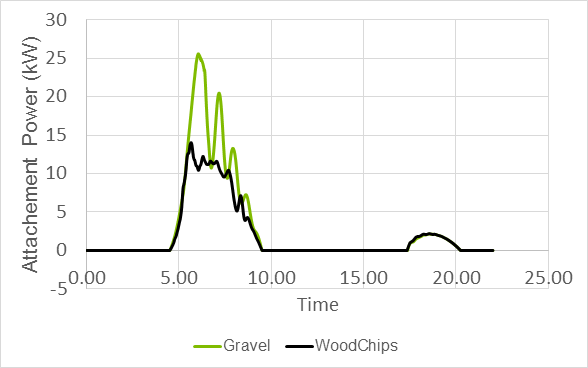
The coupled simulation determined the power requirements to move different materials for an identical set of driving motions, evaluated for two materials at far ends of the spectrum: gravel (high density, medium cohesion) and wood chips (low density, zero cohesion). That bracketed the duty the hydraulic components had to cover and gave the OEM's engineers a physics-based envelope for sizing hydraulics while the design parameters were still open.
Against traditional load-estimation approaches, the coupled EDEM and Adams simulation delivered more accurate results in less time, with no crude force models and no correlation campaign for a semi-empirical approximation. The practical effect was that engineering effort shifted from defending load estimates to using them: increased design insight, and design exploration and optimization at concept stage that was previously not obtainable.
“With a coupled Adams and EDEM methodology, headaches associated with crude force models or exhaustive efforts to develop and correlate a semi-empirical mathematical approximation can now be in the past. DSIM has adopted a simulation solution of Adams coupled with EDEM allowing their CAE process to flourish and provide customers more accurate results with increased design insight in less time.”
Darren Simoni, Principal, DSIM
Originally published as a heavy-equipment customer case study by EDEM (now Altair EDEM).
Loads You Cannot Measure Yet?
DSIM is an independent simulation consultancy providing DEM simulation and multibody dynamics consulting. If bucket, blade, or attachment loads are the open question on your machine concept, schedule a no-charge intro consultation and we will talk through whether coupled EDEM and Adams simulation can put physics-based numbers behind your component sizing before hardware exists.
Typically responds within 24 hours.
info@dsimtech.com • Post Falls, Idaho, USA